Post-hoc edge inference via shared-embedding link prediction (node2vec)
This notebook demonstrates post-hoc, shared-embedding function -> function edge inference using MagnitudeEdgeKGE (now a node2vec-style link predictor; the class name is kept for backward compatibility).
Workflow:
Train a GSNN on a partial graph.
Run
MagnitudeEdgeInfererto accumulate activation/gradient magnitude correlations.Threshold MEI scores into inferred positive edges.
Pool inferred edges with kept-graph edges into one augmented directed graph.
Learn a single shared node embedding table by skip-gram with negative sampling on random walks.
Score held-out edges by the dot product of node embeddings.
Same converging-tier DAG setup as notebooks 13-16 (12 inputs -> 24 function nodes -> 12 outputs, 16 held-out edges).
No complex2 dependency.
[75]:
from matplotlib import pyplot as plt
import numpy as np
import networkx as nx
import torch

from gsnn.models.GSNN import GSNN
from gsnn.simulate.nx2pyg import nx2pyg
from gsnn.simulate.simulate import simulate
from gsnn.optim.MagnitudeEdgeInferer import MagnitudeEdgeInferer
from gsnn.optim.MagnitudeEdgeKGE import MagnitudeEdgeKGE

from sklearn.metrics import roc_auc_score, roc_curve

torch.manual_seed(0)
np.random.seed(0)

device = 'cuda' if torch.cuda.is_available() else 'cpu'

%load_ext autoreload
%autoreload 2
The autoreload extension is already loaded. To reload it, use:
  %reload_ext autoreload
Build ground-truth graph and simulate data
[76]:
def build_convergence_graph(n_tier_a=6):
    n = n_tier_a
    G = nx.DiGraph()
    func_func_edges_TRUE = []
    input_nodes = [f'in{i}' for i in range(n)]
    tier_a = [f'f{i}' for i in range(n)]
    tier_b = [f'f{n + k}' for k in range(n - 1)]
    tier_c = [f'f{2 * n - 1}']
    function_nodes = tier_a + tier_b + tier_c
    output_nodes = [f'o{k}' for k in range(n)]
    for i, u in enumerate(input_nodes):
        G.add_edge(u, tier_a[i])
    for k in range(n - 1):
        b = tier_b[k]
        for parent in (tier_a[k], tier_a[k + 1]):
            G.add_edge(parent, b)
            func_func_edges_TRUE.append((parent, b))
    sink = tier_c[0]
    for b in tier_b:
        G.add_edge(b, sink)
        func_func_edges_TRUE.append((b, sink))
    for k, b in enumerate(tier_b):
        G.add_edge(b, output_nodes[k])
    G.add_edge(sink, output_nodes[n - 1])
    return G, input_nodes, function_nodes, output_nodes, func_func_edges_TRUE

def default_held_out_edges(n_tier_a, b2sink_stride=2):
    n = n_tier_a
    sink = f'f{2 * n - 1}'
    held = [(f'f{k}', f'f{n + k}') for k in range(1, n - 1)]
    held += [(f'f{n + k}', sink) for k in range(0, n - 1, b2sink_stride)]
    return held

N_TIER_A = 12
G, input_nodes, function_nodes, output_nodes, func_func_edges_TRUE = build_convergence_graph(N_TIER_A)
N_FUNC = len(function_nodes)
HELD_OUT_EDGES = default_held_out_edges(N_TIER_A)

x_train, x_test, y_train, y_test = simulate(
    G, n_train=2000, n_test=500,
    input_nodes=input_nodes, output_nodes=output_nodes,
    noise_scale=0.15, special_functions=None,
)
x_train = torch.tensor(x_train, dtype=torch.float32).to(device)
x_test = torch.tensor(x_test, dtype=torch.float32).to(device)
y_train = torch.tensor(y_train, dtype=torch.float32).to(device)
y_test = torch.tensor(y_test, dtype=torch.float32).to(device)
y_mu, y_std = y_train.mean(0), y_train.std(0)
y_train = (y_train - y_mu) / (y_std + 1e-8)
y_test = (y_test - y_mu) / (y_std + 1e-8)

held_out_set = set(HELD_OUT_EDGES)
G_partial = G.copy()
G_partial.remove_edges_from(HELD_OUT_EDGES)
data = nx2pyg(G_partial, input_nodes, function_nodes, output_nodes)
kept_edges = [e for e in func_func_edges_TRUE if e not in held_out_set]
kept_ff_set = set(kept_edges)

sink = f'f{2 * N_TIER_A - 1}'
left_merge = [e for e in HELD_OUT_EDGES if e[1] != sink]
b2sink = [e for e in HELD_OUT_EDGES if e[1] == sink]
rng = np.random.default_rng(0)
rng.shuffle(left_merge); rng.shuffle(b2sink)
edges_val = left_merge[:len(left_merge)//2] + b2sink[:len(b2sink)//2]
edges_test = left_merge[len(left_merge)//2:] + b2sink[len(b2sink)//2:]
held_out_benchmark = set(edges_val) | set(edges_test)

print(f'functions: {N_FUNC} | held-out val/test: {len(edges_val)}/{len(edges_test)}')
functions: 24 | held-out val/test: 8/8
Train GSNN (no auxiliary edge inference)
[77]:
BATCH_SIZE = 64

model_kwargs = dict(
    channels=8, layers=6, share_layers=False, bias=True,
    add_function_self_edges=True, norm='groupbatch', dropout=0.,
    nonlin=torch.nn.ELU, node_mlp=False, checkpoint=False,
)

model = GSNN(data.edge_index_dict, data.node_names_dict, **model_kwargs).to(device)

train_loader = torch.utils.data.DataLoader(
    torch.utils.data.TensorDataset(x_train, y_train),
    batch_size=BATCH_SIZE, shuffle=True, drop_last=True,
)
infer_loader = torch.utils.data.DataLoader(
    torch.utils.data.TensorDataset(x_train, y_train),
    batch_size=BATCH_SIZE, shuffle=False, drop_last=True,
)
gsnn_optim = torch.optim.AdamW(model.parameters(), lr=1e-3, weight_decay=0)
crit = torch.nn.MSELoss()

n_epochs = 30
for epoch in range(n_epochs):
    model.train()
    for x_batch, y_batch in train_loader:
        gsnn_optim.zero_grad()
        loss = crit(model(x_batch), y_batch)
        loss.backward()
        gsnn_optim.step()
    if epoch == 0 or (epoch + 1) % 10 == 0 or epoch == n_epochs - 1:
        model.eval()
        with torch.no_grad():
            mse = crit(model(x_test), y_test).item()
        print(f'epoch {epoch+1:2d} | test MSE {mse:.4f}')
epoch  1 | test MSE 0.7987
epoch 10 | test MSE 0.4809
epoch 20 | test MSE 0.4842
epoch 30 | test MSE 0.4804
Fit MagnitudeEdgeInferer and inspect inferred positives
[81]:
mei = MagnitudeEdgeInferer(model, data, reduction='l1')
mei.fit(infer_loader, crit=crit, device=device, verbose=False)

res_corr = mei.evaluate(layer_agg='max', score='corr')
res_partial = mei.evaluate(layer_agg='max', score='partial')

print(f'MEI samples: {mei.n}')
print('\nTop 10 inferred edges by corr (non-kept):')
display(res_corr[~res_corr['has_edge']].head(10)[
    ['src_func', 'dst_func', 'corr', 'p_value', 'q_value']
])

n_fdr = ((res_corr['q_value'] <= 0.05) & ~res_corr['has_edge']).sum()
print(f'\nFDR-significant non-kept edges (alpha=0.05): {n_fdr}')
MEI samples: 1984

Top 10 inferred edges by corr (non-kept):
| src_func | dst_func | corr | p_value | q_value | |
|---|---|---|---|---|---|
| 0 | f4 | f16 | 0.889384 | 0.0 | 0.0 |
| 1 | f2 | f14 | 0.881459 | 0.0 | 0.0 |
| 2 | f2 | f3 | 0.878537 | 0.0 | 0.0 |
| 3 | f10 | f22 | 0.876956 | 0.0 | 0.0 |
| 4 | f1 | f13 | 0.866949 | 0.0 | 0.0 |
| 5 | f18 | f8 | 0.863582 | 0.0 | 0.0 |
| 6 | f3 | f15 | 0.863015 | 0.0 | 0.0 |
| 7 | f18 | f19 | 0.862077 | 0.0 | 0.0 |
| 8 | f10 | f11 | 0.861264 | 0.0 | 0.0 |
| 9 | f4 | f5 | 0.857633 | 0.0 | 0.0 |
FDR-significant non-kept edges (alpha=0.05): 106
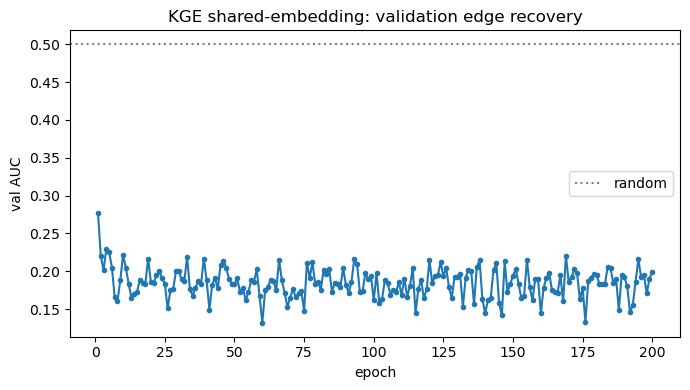
Validation AUC vs epoch
[86]:
if 'val_auc' in history:
    fig, ax = plt.subplots(figsize=(7, 4))
    ax.plot(range(1, len(history['val_auc']) + 1), history['val_auc'], marker='o', ms=3)
    ax.axhline(0.5, color='k', ls=':', alpha=0.5, label='random')
    ax.set_xlabel('epoch'); ax.set_ylabel('val AUC')
    ax.set_title('KGE shared-embedding: validation edge recovery')
    ax.legend(); plt.tight_layout(); plt.show()
Head-to-head comparison on test held-out edges
[87]:
def roc_auc_for_edges(res_df, positive_edges, score_col='score'):
    pos_set = set(positive_edges)
    pos = res_df[res_df.apply(lambda r: (r['src_func'], r['dst_func']) in pos_set, axis=1)][score_col].dropna().values
    neg = res_df[~res_df.apply(lambda r: (r['src_func'], r['dst_func']) in pos_set, axis=1)]
    neg = neg[neg.apply(lambda r: (r['src_func'], r['dst_func']) not in kept_ff_set, axis=1)][score_col].dropna().values
    if len(pos) == 0 or len(neg) == 0:
        return float('nan')
    return roc_auc_score(
        np.concatenate([np.ones(len(pos)), np.zeros(len(neg))]),
        np.concatenate([pos, neg]),
    )

def fit_kge_variant(name, *, edges_to_use='joint', n_epochs=200):
    """Refit a KGE variant. ``edges_to_use`` controls the positive pool."""
    k = MagnitudeEdgeKGE(
        mei,
        embedding_dim=32,
        score='corr',
        layer_agg='max',
        mining_strategy='fdr',
        fdr_alpha=0.05,
        walks_per_node=20, walk_length=10, window_size=5, n_negatives=5,
        walk_undirected=True, walk_corr_weighted=True, walk_alpha=2.0,
        lr=1e-2, weight_decay=1e-4,
        exclude_edges=held_out_benchmark,
    ).to(device)
    if edges_to_use == 'inferred':
        k.pos_heads = k.inferred_heads
        k.pos_tails = k.inferred_tails
    elif edges_to_use == 'true':
        k.pos_heads = k.true_heads
        k.pos_tails = k.true_tails
    pm = torch.zeros(k.N, k.N, dtype=torch.bool)
    if k.pos_heads.numel() > 0:
        pm[k.pos_heads, k.pos_tails] = True
    k.pos_mask = pm
    k._build_adjacency()
    k.fit(n_epochs=n_epochs, batch_size=2048, validation_edges=edges_val, verbose=False)
    k.load_best()
    return k

res_kge_joint = kge.evaluate()
kge_inferred_only = fit_kge_variant('inferred-only', edges_to_use='inferred')
kge_true_only = fit_kge_variant('true-only', edges_to_use='true')
res_kge_inf = kge_inferred_only.evaluate()
res_kge_true = kge_true_only.evaluate()

results = {
    'MEI corr': (res_corr, 'corr'),
    'MEI partial': (res_partial, 'corr'),
    'KGE joint (kept + inferred)': (res_kge_joint, 'score'),
    'KGE inferred-only': (res_kge_inf, 'score'),
    'KGE true-only': (res_kge_true, 'score'),
}

print('Test-set ROC-AUC:')
for name, (df, col) in results.items():
    print(f'  {name:28s}: {roc_auc_for_edges(df, edges_test, score_col=col):.3f}')

print('\nWithin-target ranking (test held-out):')
for name, (df, col) in results.items():
    score_col = 'score' if col == 'score' else col
    if col != 'score':
        df = df.rename(columns={'corr': 'score'})
    _, summary = MagnitudeEdgeKGE.evaluate_target_ranking(df, edges_test, score_col='score')
    print(f"  {name:28s}: MRR={summary['mrr']:.3f} top@1={summary['top@1']:.3f}")
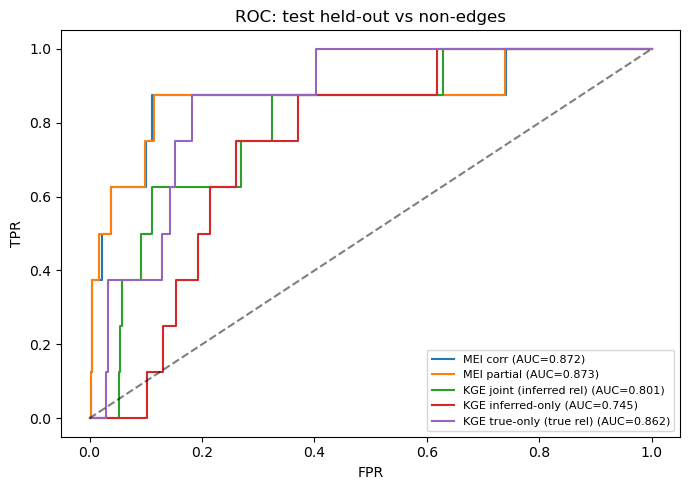
Test-set ROC-AUC:
  MEI corr                    : 0.872
  MEI partial                 : 0.873
  KGE joint (kept + inferred) : 0.463
  KGE inferred-only           : 0.634
  KGE true-only               : 0.190

Within-target ranking (test held-out):
  MEI corr                    : MRR=0.672 top@1=0.625
  MEI partial                 : MRR=0.674 top@1=0.625
  KGE joint (kept + inferred) : MRR=0.083 top@1=0.000
  KGE inferred-only           : MRR=0.125 top@1=0.000
  KGE true-only               : MRR=0.065 top@1=0.000
ROC curves
[ ]:
fig, ax = plt.subplots(figsize=(7, 5))
for name, (df, col) in results.items():
    pos_set = set(edges_test)
    pos = df[df.apply(lambda r: (r['src_func'], r['dst_func']) in pos_set, axis=1)][col].dropna().values
    neg = df[~df.apply(lambda r: (r['src_func'], r['dst_func']) in pos_set, axis=1)]
    neg = neg[neg.apply(lambda r: (r['src_func'], r['dst_func']) not in kept_ff_set, axis=1)][col].dropna().values
    if len(pos) == 0 or len(neg) == 0:
        continue
    y_true = np.concatenate([np.ones(len(pos)), np.zeros(len(neg))])
    y_score = np.concatenate([pos, neg])
    auc = roc_auc_score(y_true, y_score)
    fpr, tpr, _ = roc_curve(y_true, y_score)
    ax.plot(fpr, tpr, label=f'{name} (AUC={auc:.3f})')
ax.plot([0, 1], [0, 1], 'k--', alpha=0.5)
ax.set_xlabel('FPR'); ax.set_ylabel('TPR')
ax.set_title('ROC: test held-out vs non-edges')
ax.legend(fontsize=8); plt.tight_layout(); plt.show()
Discussion
MagnitudeEdgeKGE is a post-hoc shared-embedding link predictor on top of Tier-0 magnitude correlation:
MEI mining - FDR-significant (or top-K) non-kept edges from
MagnitudeEdgeInfererbecome inferred positives.Structural prior - kept function-function edges and inferred edges are pooled into a single augmented directed graph; every edge pushes the same node embedding table.
Anti-leakage - pass held-out benchmark edges via
exclude_edgesso they are never trained as inferred positives.Scalability - parameter count is
O(N * d)(one shared embedding table) rather thanO(N^2).
Compare ablations:
MEI corr / partial - direct correlation scores (no embedding).
KGE true-only - structural link prediction baseline trained on kept edges only.
KGE inferred-only - MEI-mined positives only, no graph prior.
KGE joint - both pooled into one shared embedding space.
The shared embedding will only beat raw MEI correlation when (a) the kept graph is large and densely structured (so transitivity through kept edges constrains test edges) and (b) MEI per-edge estimates are noisy enough that pooling helps. On small toy graphs MEI correlation is hard to beat because the mining step discards continuous score information.