Function Edge Inferer
[1]:
from matplotlib import pyplot as plt
import numpy as np
import networkx as nx
import torch

from gsnn.models.GSNN import GSNN
from gsnn.simulate.nx2pyg import nx2pyg
from gsnn.simulate.simulate import simulate

from sklearn.metrics import roc_auc_score, roc_curve
from gsnn.optim.FunctionEdgeInferer import FunctionEdgeInferer

torch.manual_seed(0)
np.random.seed(0)

device = 'cuda' if torch.cuda.is_available() else 'cpu'

%load_ext autoreload
%autoreload 2
Build ground-truth graph and simulate data
[2]:
def build_convergence_graph(n_tier_a=6):
    n = n_tier_a
    G = nx.DiGraph()
    func_func_edges_TRUE = []
    input_nodes = [f'in{i}' for i in range(n)]
    tier_a = [f'f{i}' for i in range(n)]
    tier_b = [f'f{n + k}' for k in range(n - 1)]
    tier_c = [f'f{2 * n - 1}']
    function_nodes = tier_a + tier_b + tier_c
    output_nodes = [f'o{k}' for k in range(n)]
    for i, u in enumerate(input_nodes):
        G.add_edge(u, tier_a[i])
    for k in range(n - 1):
        b = tier_b[k]
        for parent in (tier_a[k], tier_a[k + 1]):
            G.add_edge(parent, b)
            func_func_edges_TRUE.append((parent, b))
    sink = tier_c[0]
    for b in tier_b:
        G.add_edge(b, sink)
        func_func_edges_TRUE.append((b, sink))
    for k, b in enumerate(tier_b):
        G.add_edge(b, output_nodes[k])
    G.add_edge(sink, output_nodes[n - 1])
    return G, input_nodes, function_nodes, output_nodes, func_func_edges_TRUE

def default_held_out_edges(n_tier_a, b2sink_stride=2):
    n = n_tier_a
    sink = f'f{2 * n - 1}'
    held = [(f'f{k}', f'f{n + k}') for k in range(1, n - 1)]
    held += [(f'f{n + k}', sink) for k in range(0, n - 1, b2sink_stride)]
    return held

N_TIER_A = 25
G, input_nodes, function_nodes, output_nodes, func_func_edges_TRUE = build_convergence_graph(N_TIER_A)
N_FUNC = len(function_nodes)
HELD_OUT_EDGES = default_held_out_edges(N_TIER_A)

x_train, x_test, y_train, y_test = simulate(
    G, n_train=1000, n_test=500,
    input_nodes=input_nodes, output_nodes=output_nodes,
    noise_scale=0.25, special_functions=None,
)
x_train = torch.tensor(x_train, dtype=torch.float32).to(device)
x_test = torch.tensor(x_test, dtype=torch.float32).to(device)
y_train = torch.tensor(y_train, dtype=torch.float32).to(device)
y_test = torch.tensor(y_test, dtype=torch.float32).to(device)
y_mu, y_std = y_train.mean(0), y_train.std(0)
y_train = (y_train - y_mu) / (y_std + 1e-8)
y_test = (y_test - y_mu) / (y_std + 1e-8)

held_out_set = set(HELD_OUT_EDGES)
G_partial = G.copy()
G_partial.remove_edges_from(HELD_OUT_EDGES)
data = nx2pyg(G_partial, input_nodes, function_nodes, output_nodes)
kept_edges = [e for e in func_func_edges_TRUE if e not in held_out_set]
kept_ff_set = set(kept_edges)

sink = f'f{2 * N_TIER_A - 1}'
left_merge = [e for e in HELD_OUT_EDGES if e[1] != sink]
b2sink = [e for e in HELD_OUT_EDGES if e[1] == sink]
rng = np.random.default_rng(0)
rng.shuffle(left_merge); rng.shuffle(b2sink)
edges_val = left_merge[:len(left_merge)//2] + b2sink[:len(b2sink)//2]
edges_test = left_merge[len(left_merge)//2:] + b2sink[len(b2sink)//2:]
held_out_benchmark = set(edges_val) | set(edges_test)

print(f'functions: {N_FUNC} | held-out val/test: {len(edges_val)}/{len(edges_test)}')
functions: 50 | held-out val/test: 17/18
[3]:
node_names = data.node_names_dict['function']

edge_index_val = torch.stack((torch.tensor([node_names.index(e[0]) for e in edges_val]),
                              torch.tensor([node_names.index(e[1]) for e in edges_val])),
                              dim=0)

edge_index_test = torch.stack((torch.tensor([node_names.index(e[0]) for e in edges_test]),
                              torch.tensor([node_names.index(e[1]) for e in edges_test])),
                              dim=0)

print('n val edges', edge_index_val.shape[1])
print('n test edges', edge_index_test.shape[1])

from gsnn.optim.FunctionEdgeInferer import mrr

def report(model, crit):

    FEI = FunctionEdgeInferer(model, crit, edge_index=data.edge_index_dict['function','to','function'],
                            use_prenorm=True, device='cpu', norm='l1', agg='sum')
    W = FEI.fit(x_test, y_test, method='spearman', penalty_factor=0.0, scale_by_act_mean=False,
                bootstrap=False, bootstrap_iters=1)

    all_true_edges = torch.cat((data.edge_index_dict['function','to','function'],
                                edge_index_val, edge_index_test), dim=1)
    val_mrr = mrr(torch.tensor(W), edge_index_val, all_true_edges)
    test_mrr = mrr(torch.tensor(W), edge_index_test, all_true_edges)
    random_mrr = mrr(torch.rand(W.shape), edge_index_val, all_true_edges)

    return val_mrr, test_mrr, random_mrr
n val edges 17
n test edges 18
Train GSNN
[14]:
BATCH_SIZE = 128

model_kwargs = dict(
    channels=10, layers=6, share_layers=False, bias=True,
    add_function_self_edges=True, norm='none', dropout=0.2,
    nonlin=torch.nn.ELU, node_mlp=False, checkpoint=False,
)

model = GSNN(data.edge_index_dict, data.node_names_dict, **model_kwargs).to(device)

train_loader = torch.utils.data.DataLoader(
    torch.utils.data.TensorDataset(x_train, y_train),
    batch_size=BATCH_SIZE, shuffle=True, drop_last=True,
)
infer_loader = torch.utils.data.DataLoader(
    torch.utils.data.TensorDataset(x_train, y_train),
    batch_size=BATCH_SIZE, shuffle=False, drop_last=True,
)
gsnn_optim = torch.optim.AdamW(model.parameters(), lr=1e-3, weight_decay=0)
crit = torch.nn.MSELoss()

n_epochs = 50
val_mrrs = []; test_mrrs = []; random_mrrs = []
for epoch in range(n_epochs):
    model.train()
    for x_batch, y_batch in train_loader:
        gsnn_optim.zero_grad()
        loss = crit(model(x_batch), y_batch)
        loss.backward()
        gsnn_optim.step()
    if epoch == 0 or (epoch + 1) % 1 == 0 or epoch == n_epochs - 1:
        model.eval()
        with torch.no_grad():
            mse = crit(model(x_test), y_test).item()

        val_mrr, test_mrr, random_mrr = report(model, crit)
        val_mrrs.append(val_mrr); test_mrrs.append(test_mrr); random_mrrs.append(random_mrr)
        print(f'epoch {epoch+1:2d} | test MSE {mse:.4f} | val MRR {val_mrr:.4f} | test MRR {test_mrr:.4f} | random MRR {random_mrr:.4f}')


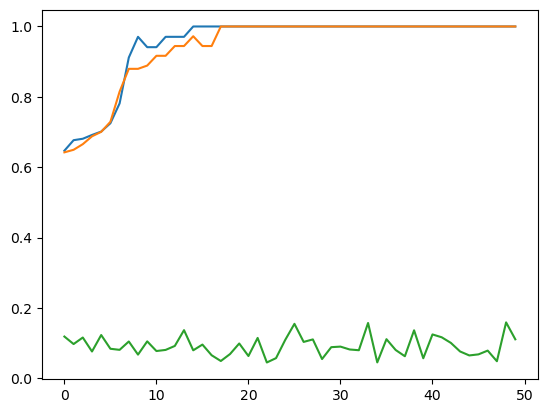
plt.figure()
plt.plot(val_mrrs)
plt.plot(test_mrrs)
plt.plot(random_mrrs)
plt.show()
epoch  1 | test MSE 1.0245 | val MRR 0.6471 | test MRR 0.6423 | random MRR 0.1189
epoch  2 | test MSE 1.0162 | val MRR 0.6769 | test MRR 0.6496 | random MRR 0.0975
epoch  3 | test MSE 1.0031 | val MRR 0.6810 | test MRR 0.6656 | random MRR 0.1161
epoch  4 | test MSE 0.9831 | val MRR 0.6917 | test MRR 0.6879 | random MRR 0.0764
epoch  5 | test MSE 0.9549 | val MRR 0.7013 | test MRR 0.7006 | random MRR 0.1232
epoch  6 | test MSE 0.9163 | val MRR 0.7250 | test MRR 0.7292 | random MRR 0.0841
epoch  7 | test MSE 0.8654 | val MRR 0.7814 | test MRR 0.8148 | random MRR 0.0811
epoch  8 | test MSE 0.8024 | val MRR 0.9118 | test MRR 0.8796 | random MRR 0.1048
epoch  9 | test MSE 0.7303 | val MRR 0.9706 | test MRR 0.8796 | random MRR 0.0676
epoch 10 | test MSE 0.6591 | val MRR 0.9412 | test MRR 0.8889 | random MRR 0.1052
epoch 11 | test MSE 0.6016 | val MRR 0.9412 | test MRR 0.9167 | random MRR 0.0777
epoch 12 | test MSE 0.5694 | val MRR 0.9706 | test MRR 0.9167 | random MRR 0.0809
epoch 13 | test MSE 0.5569 | val MRR 0.9706 | test MRR 0.9444 | random MRR 0.0922
epoch 14 | test MSE 0.5526 | val MRR 0.9706 | test MRR 0.9444 | random MRR 0.1370
epoch 15 | test MSE 0.5517 | val MRR 1.0000 | test MRR 0.9722 | random MRR 0.0798
epoch 16 | test MSE 0.5513 | val MRR 1.0000 | test MRR 0.9444 | random MRR 0.0960
epoch 17 | test MSE 0.5505 | val MRR 1.0000 | test MRR 0.9444 | random MRR 0.0657
epoch 18 | test MSE 0.5499 | val MRR 1.0000 | test MRR 1.0000 | random MRR 0.0494
epoch 19 | test MSE 0.5489 | val MRR 1.0000 | test MRR 1.0000 | random MRR 0.0691
epoch 20 | test MSE 0.5482 | val MRR 1.0000 | test MRR 1.0000 | random MRR 0.0992
epoch 21 | test MSE 0.5482 | val MRR 1.0000 | test MRR 1.0000 | random MRR 0.0635
epoch 22 | test MSE 0.5480 | val MRR 1.0000 | test MRR 1.0000 | random MRR 0.1150
epoch 23 | test MSE 0.5482 | val MRR 1.0000 | test MRR 1.0000 | random MRR 0.0452
epoch 24 | test MSE 0.5480 | val MRR 1.0000 | test MRR 1.0000 | random MRR 0.0576
epoch 25 | test MSE 0.5482 | val MRR 1.0000 | test MRR 1.0000 | random MRR 0.1094
epoch 26 | test MSE 0.5482 | val MRR 1.0000 | test MRR 1.0000 | random MRR 0.1550
epoch 27 | test MSE 0.5483 | val MRR 1.0000 | test MRR 1.0000 | random MRR 0.1036
epoch 28 | test MSE 0.5483 | val MRR 1.0000 | test MRR 1.0000 | random MRR 0.1107
epoch 29 | test MSE 0.5485 | val MRR 1.0000 | test MRR 1.0000 | random MRR 0.0550
epoch 30 | test MSE 0.5477 | val MRR 1.0000 | test MRR 1.0000 | random MRR 0.0887
epoch 31 | test MSE 0.5476 | val MRR 1.0000 | test MRR 1.0000 | random MRR 0.0903
epoch 32 | test MSE 0.5481 | val MRR 1.0000 | test MRR 1.0000 | random MRR 0.0821
epoch 33 | test MSE 0.5482 | val MRR 1.0000 | test MRR 1.0000 | random MRR 0.0800
epoch 34 | test MSE 0.5479 | val MRR 1.0000 | test MRR 1.0000 | random MRR 0.1574
epoch 35 | test MSE 0.5477 | val MRR 1.0000 | test MRR 1.0000 | random MRR 0.0454
epoch 36 | test MSE 0.5478 | val MRR 1.0000 | test MRR 1.0000 | random MRR 0.1114
epoch 37 | test MSE 0.5478 | val MRR 1.0000 | test MRR 1.0000 | random MRR 0.0806
epoch 38 | test MSE 0.5479 | val MRR 1.0000 | test MRR 1.0000 | random MRR 0.0629
epoch 39 | test MSE 0.5480 | val MRR 1.0000 | test MRR 1.0000 | random MRR 0.1366
epoch 40 | test MSE 0.5480 | val MRR 1.0000 | test MRR 1.0000 | random MRR 0.0572
epoch 41 | test MSE 0.5476 | val MRR 1.0000 | test MRR 1.0000 | random MRR 0.1249
epoch 42 | test MSE 0.5477 | val MRR 1.0000 | test MRR 1.0000 | random MRR 0.1168
epoch 43 | test MSE 0.5477 | val MRR 1.0000 | test MRR 1.0000 | random MRR 0.1008
epoch 44 | test MSE 0.5477 | val MRR 1.0000 | test MRR 1.0000 | random MRR 0.0765
epoch 45 | test MSE 0.5476 | val MRR 1.0000 | test MRR 1.0000 | random MRR 0.0652
epoch 46 | test MSE 0.5471 | val MRR 1.0000 | test MRR 1.0000 | random MRR 0.0682
epoch 47 | test MSE 0.5470 | val MRR 1.0000 | test MRR 1.0000 | random MRR 0.0789
epoch 48 | test MSE 0.5472 | val MRR 1.0000 | test MRR 1.0000 | random MRR 0.0487
epoch 49 | test MSE 0.5472 | val MRR 1.0000 | test MRR 1.0000 | random MRR 0.1591
epoch 50 | test MSE 0.5479 | val MRR 1.0000 | test MRR 1.0000 | random MRR 0.1110
[61]:
from gsnn.optim.FunctionEdgeInferer import _get_node_attrs
a,g = _get_node_attrs(model=model, crit=crit, x=x_train, y=y_train)
[63]:
obs_idx = 1

a_obs = a[obs_idx]  # (N_func,)
g_obs = g[obs_idx]   # (N_func,)

name2idx = {n: i for i, n in enumerate(node_names)}
def node_values(vec):
    return [vec[name2idx[n]] if n in name2idx else 0.0 for n in G.nodes()]

pos = nx.spring_layout(G, k=1, seed=0)

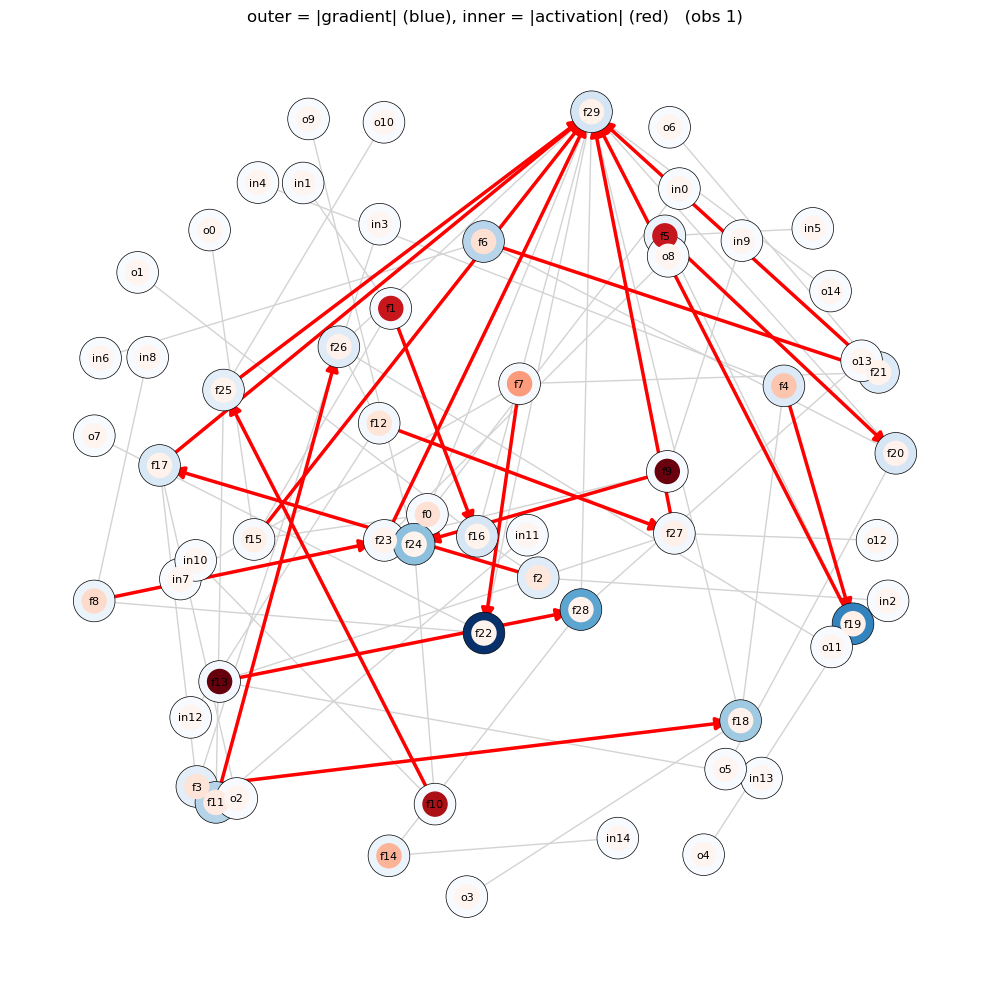
fig, ax = plt.subplots(figsize=(10, 10))

nx.draw_networkx_edges(G, pos=pos, ax=ax, edge_color='lightgray')
nx.draw_networkx_edges(
    G, pos=pos, ax=ax,
    edgelist=HELD_OUT_EDGES,
    edge_color='red', width=2.5, arrowsize=18,
)

outer_size, inner_size = 900, 300
nodelist = list(G.nodes())

nx.draw_networkx_nodes(
    G, pos=pos, ax=ax, nodelist=nodelist,
    node_color=node_values(g_obs), cmap='Blues', vmin=0,
    node_size=outer_size, edgecolors='black', linewidths=0.5,
)
nx.draw_networkx_nodes(
    G, pos=pos, ax=ax, nodelist=nodelist,
    node_color=node_values(a_obs), cmap='Reds', vmin=0,
    node_size=inner_size,
)
nx.draw_networkx_labels(G, pos=pos, ax=ax, font_size=8)

ax.set_title(f'outer = |gradient| (blue), inner = |activation| (red)   (obs {obs_idx})')
ax.axis('off')

plt.tight_layout()
plt.show()
[151]:
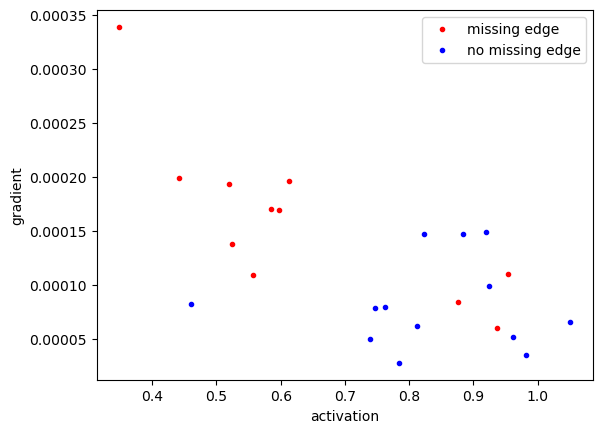
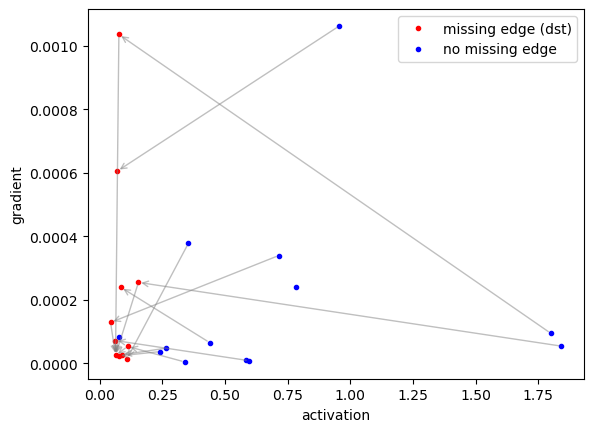
# Nodes that are missing an edge typically have low activation and high gradient

node_names = data.node_names_dict['function']
nodes_missing_an_edge = [node_names.index(dst) for src, dst in HELD_OUT_EDGES]
M = torch.zeros(N)
M[nodes_missing_an_edge] = 1

obs_idx = 1
a_obs = a[obs_idx].detach().cpu().numpy()   # (N_func,)
g_obs = g[obs_idx].detach().cpu().numpy()   # (N_func,)

fig, ax = plt.subplots()
ax.plot(a_obs[M == 1], g_obs[M == 1], 'r.', label='missing edge (dst)')
ax.plot(a_obs[M == 0], g_obs[M == 0], 'b.', label='no missing edge')

for src_name, dst_name in HELD_OUT_EDGES:
    i = node_names.index(src_name)
    j = node_names.index(dst_name)
    ax.annotate(
        '', xy=(a_obs[j], g_obs[j]), xytext=(a_obs[i], g_obs[i]),
        arrowprops=dict(arrowstyle='->', color='gray', alpha=0.5, lw=1),
    )

ax.set_xlabel('activation')
ax.set_ylabel('gradient')
ax.legend()
plt.show()
[149]:
from sklearn.linear_model import LogisticRegression
from sklearn.metrics import roc_auc_score

a_np = a.detach().cpu().numpy()                                # (B, N)
g_np = g.detach().cpu().numpy()                                # (B, N)
M_np = M.numpy()                                               # (N,)
B, N_nodes = a_np.shape

y = np.broadcast_to(M_np, (B, N_nodes)).reshape(-1)            # (B*N,)
x = np.stack([a_np.reshape(-1), g_np.reshape(-1)], axis=1)     # (B*N, 2)

clf = LogisticRegression(penalty=None, max_iter=1000)
clf.fit(x, y)

w_act, w_grad = clf.coef_[0]
print(f'classes:        {clf.classes_.tolist()}')
print(f'intercept:      {clf.intercept_[0]:+.4f}')
print(f'weight act:     {w_act:+.4f}')
print(f'weight grad:    {w_grad:+.4f}')
print(f'train accuracy: {clf.score(x, y):.4f}')
print(f'train ROC AUC:  {roc_auc_score(y, clf.predict_proba(x)[:, 1]):.4f}')
classes:        [0.0, 1.0]
intercept:      +0.2804
weight act:     -0.6189
weight grad:    +0.0013
train accuracy: 0.5985
train ROC AUC:  0.6265
/home/exacloud/gscratch/mcweeney_lab/evans/external/miniforge3/envs/gsnn/lib/python3.11/site-packages/sklearn/linear_model/_logistic.py:1135: FutureWarning: 'penalty' was deprecated in version 1.8 and will be removed in 1.10. To avoid this warning, leave 'penalty' set to its default value and use 'l1_ratio' or 'C' instead. Use l1_ratio=0 instead of penalty='l2', l1_ratio=1 instead of penalty='l1', and C=np.inf instead of penalty=None.
  warnings.warn(
[165]:
A_mean = a.mean(0)
G_mean = g.mean(0)

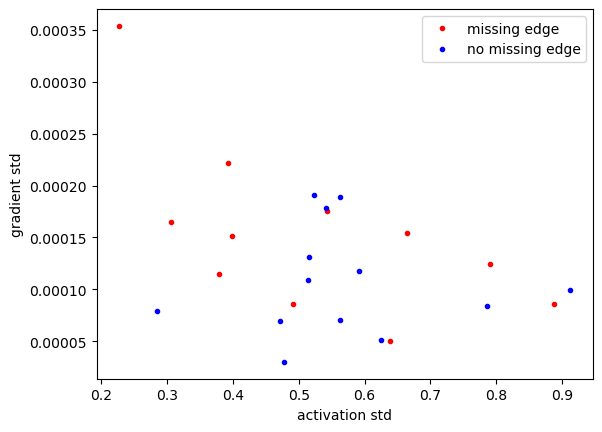
A_std = a.std(0)
G_std = g.std(0)

plt.figure()
plt.plot(A_mean[M==1], G_mean[M==1], 'r.', label='missing edge')
plt.plot(A_mean[M==0], G_mean[M==0], 'b.', label='no missing edge')
plt.xlabel('activation')
plt.ylabel('gradient')
plt.legend()
plt.show()

plt.figure()
plt.plot(A_std[M==1], G_std[M==1], 'r.', label='missing edge')
plt.plot(A_std[M==0], G_std[M==0], 'b.', label='no missing edge')
plt.xlabel('activation std')
plt.ylabel('gradient std')
plt.legend()
plt.show()